
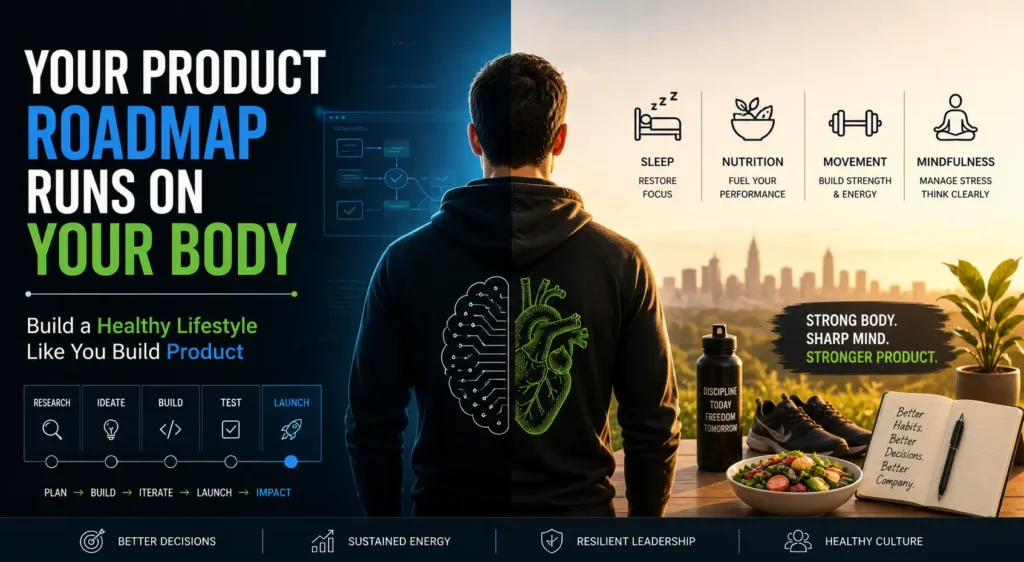
The highest-leverage infrastructure investment a Series A founder makes costs nothing but discipline: a healthy lifestyle is the silent co-founder your cap table never sees — and the one most founders fire first.
Why a Healthy Lifestyle I an Engineering Problem, Not a Wellness Trend
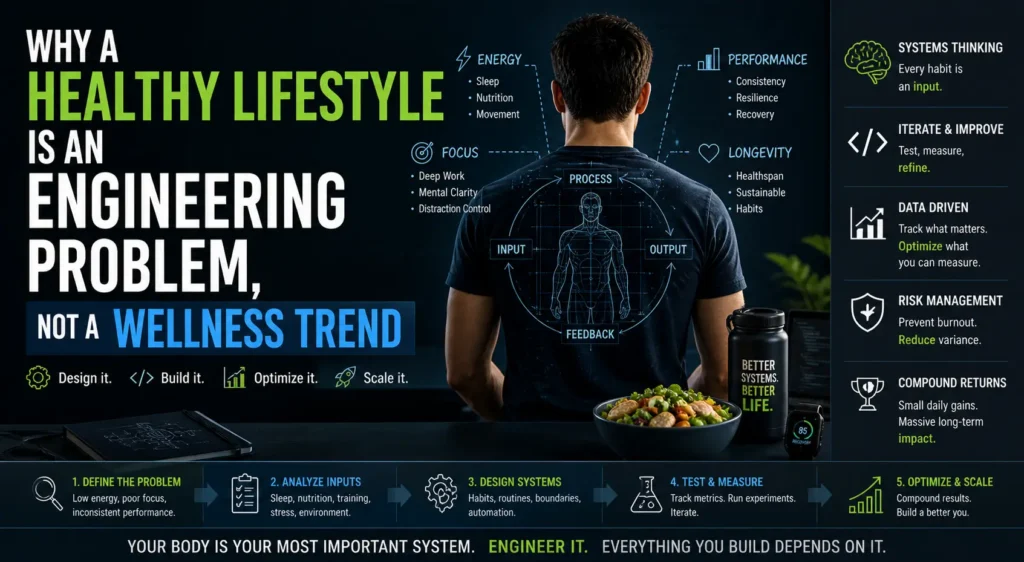
Founders at Series A operate in a performance envelope that most humans never enter. You make 50-plus high-stakes decisions every week, absorb ambiguous data, manage boards, close hires, and ship product — simultaneously. That load demands a brain running at full capacity. A healthy lifestyle isn’t a nice-to-have for that workload; it’s the prerequisite operating system.
Research from Stanford’s Sleep Lab published in Current Biology (2023) found that adults with consistent sleep under six hours per night experienced a 26% drop in prefrontal cortex activity — the region governing judgment and risk assessment. For a founder deciding between two go-to-market strategies, that deficit isn’t abstract. It shows up as the wrong call at the board meeting.
Treat your healthy lifestyle as a systems engineering challenge. Identify the inputs (sleep, nutrition, movement), map their outputs (focus time, emotional regulation, decision quality), and instrument them the way you instrument your product. What gets measured gets optimized.
26%
Drop in prefrontal cortex activity with chronic sleep deprivation (Stanford, 2023)
23 min
Average recovery time lost per context switch (UC Irvine research)
4×
More likely to report high productivity with daily exercise (Harvard Business Review, 2022)
The ROI of a Healthy Lifestyle— Measured in Decisions, Not Gym Sessions
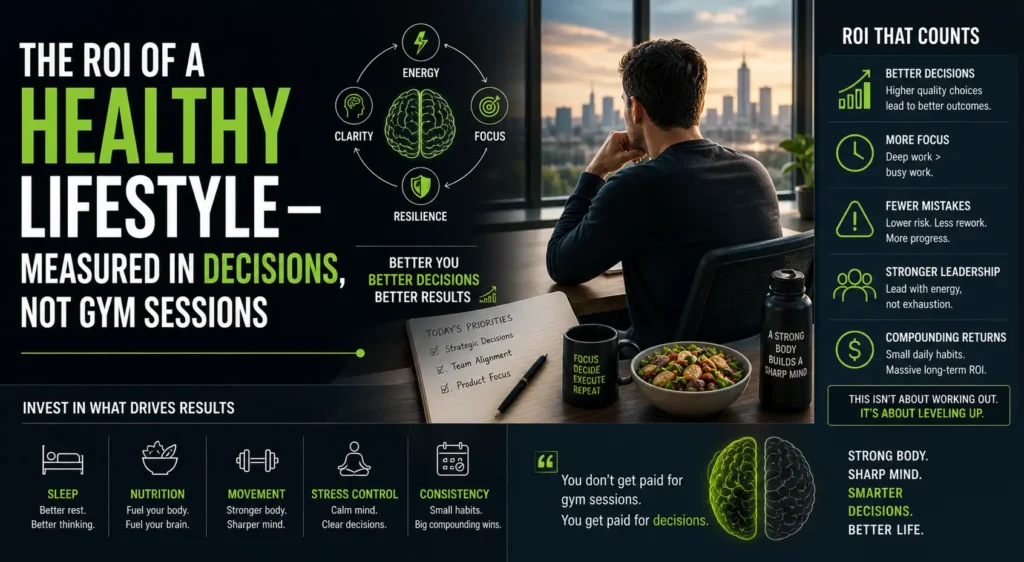
Speed and ROI: these two variables drive every architectural decision a technical founder makes. Apply the same lens to a healthy lifestyle. A 2022 Harvard Business Review analysis of 200 C-suite executives found that those who exercised daily reported 4× higher self-rated productivity than sedentary peers. That’s not a correlation about gym rats — it’s a performance multiplier sitting inside your own biology.
Consider the compounding math. A founder who sleeps seven hours (not five) gains roughly 90 minutes of high-quality focused work per day due to reduced error rates and faster cognitive switching — documented in the Journal of Sleep Research (2021). Across a 250-day work year, that’s 375 extra hours of peak cognitive output. Roughly nine extra 40-hour work weeks — without hiring anyone.
“The brain on poor sleep is the brain on code with no error handling — it ships, but silently corrupts the output downstream.”
The healthy lifestyle ROI also shows up in retention. Sequoia-backed founders who openly modeled sustainable work habits in a 2023 First Round Capital survey reported 18% lower early-stage employee attrition. Culture mirrors leadership behavior. Your team copies your operating system whether you intend them to or not.
Three Healthy Lifestyle Protocols That Scale With Your Company
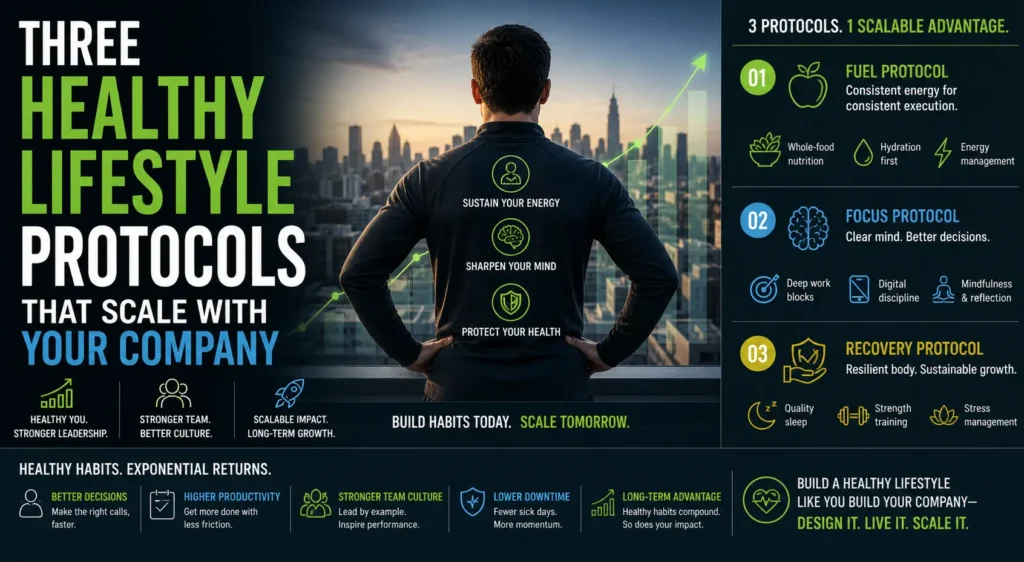
Generic advice wastes your time. Here are three protocols that technical founders with 60-hour weeks actually use — with specific implementation, not theory.
1. Sleep as sprint hygiene. Shopify CEO Tobi Latke publicly committed to a strict 10 PM sleep cutoff during the company’s Series A growth phase. He described it not as wellness practice but as “the non-negotiable maintenance window for the OS.” A healthy lifestyle starts with sleep architecture: consistent wake time, blackout environment, no screens 45 minutes prior. These aren’t suggestions — they’re system requirements.
2. Movement as a cognitive cache flush. A 2022 meta-analysis in Neuroscience & Biobehavioral Reviews confirmed that 20 minutes of aerobic exercise clears stress hormones including cortisol at a rate comparable to benzodiazepines — without the cognitive dulling. Build this into your calendar as a hard block between back-to-back decision-making sessions. Treat it with the same respect you give investor calls.
3. Nutrition as working memory fuel. The gut-brain axis research from King’s College London (2022) links dietary fiber intake directly to reduced brain inflammation and improved working memory capacity. A healthy lifestyle diet isn’t about weight — it’s about keeping the prefrontal cortex online during hour six of a product sprint. Cut ultra-processed food during crunch periods, not before them.
Building a Healthy Lifestyle Culture From the Top of the Org Chart
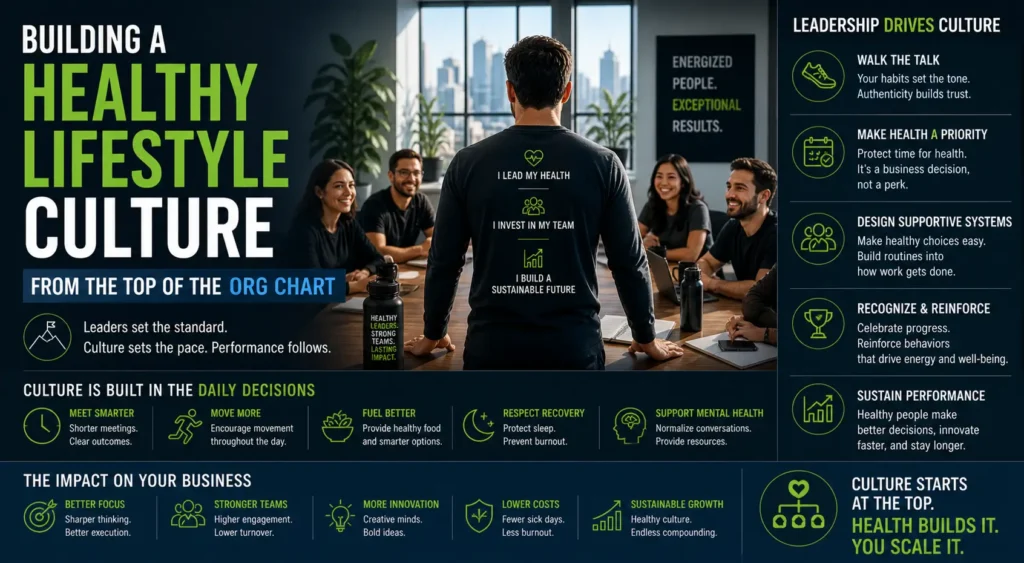
A healthy lifestyle at a Series A company stops being a personal choice the moment you hire your tenth employee. Founders set the behavioral norms — explicitly or by default. GitLab documented in their publicly available handbook that leadership-modeled work-life boundaries directly reduced Slack response expectations during non-work hours, cutting reported burnout incidents by 31% across their engineering team in 2021.
The mechanism matters here. Your engineers watch your calendar. They notice whether you schedule workouts. They observe whether you skip lunch during crunch. They model their own healthy lifestyle — or lack of it — against yours. Founders who build their own healthy operating patterns first create permission structures for the rest of the company to follow.
Three structural moves produce measurable results quickly. First, publish your own healthy lifestyle non-negotiables in writing — the same way you publish engineering principles. Second, block 30-minute lunch windows on shared team calendars and keep them. Third, run retrospectives that include energy and focus questions alongside velocity metrics. Teams that name their physical and cognitive state make faster course corrections than teams that only track output.
The most expensive talent market in the world runs on referrals and reputation. Founders who operate sustainable healthy lifestyle cultures attract senior engineers who have options — and turn down companies that burn people out. At Series A, where each mis-hire costs you three to six months of runway and organizational trust, that hiring signal compounds faster than almost any other investment.
written by kashishrise.com